Now that spring is here, and summer on the way, it’s time to remind ourselves of the healing qualities of nature. Wellness coach, forest bathing expert* and children's author Nigel Grimes is helping families rediscover the joy of slow time outdoors without screens, pressure or the need for perfection. His mindful activities are fun for the whole family.
Published
Nigel says: ‘Studies show that children who spend more time outdoors experience lower levels of anxiety, improved focus and stronger immune systems. Exposure to natural light and unstructured play boosts mood-regulating chemicals like serotonin and dopamine. It creates happier children which equals less stress for parents, carers and teachers. Even a couple of hours per week in woodlands, parks, gardens or small community green spaces will support your family’s mental, cognitive and physical health.
‘We’re learning that nature doesn’t just make children happy, it makes them more resilient,’ he adds. ‘Every moment outdoors is medicine for mind, body and heart. Plus, when children learn to love nature, they also learn to care about nature in a practical way, which can only make for a happier, healthier planet.
Studies show that children who spend more time outdoors experience lower levels of anxiety, improved focus and stronger immune systems.
Try these nature games/mindful moments that are fun, and beneficial, for the whole family.
Go on a scavenger hunt
Take note of nature’s noises – what can you hear? Birds singing?
Leaves shuffling? A stream? Work out which direction the sounds are
coming from. Flowing water is the most calming sound to listen to, so
take some time to sit by a bubbling stream. Birdsong is also very
calming.
Try a texture trail
Find something soft, something hard, one rough, one smooth, one hairy
and one tickly. Did you know that touch is the first sense to develop
before we are born?
Move mindfully
Walk slowly, walk backwards, walk on all fours like a fox and crawl
like a worm. Did you know that ants are one of very few animals that can
easily walk backwards?
See the unseen
Without moving your eyes or head, try to see what’s above and below
your eye level and to the left and right. Notice what is there but you
hadn’t spotted before. Did you know that amongst mammals, human eyes are
the best at seeing shades of green? And that lets us enjoy a wonderful
feeling of calm.
Breathe with a tree
Put your hand on a tree trunk. Breathe in and out slowly through your
nose. Did you know trees breathe in carbon dioxide and breathe out
oxygen, the opposite to people?
Press leaves
Take home a favourite fallen leaf as a souvenir and press it if you
can. Did you know that the insect family Phylliidae is referred to as
the ‘walking leaf’ as it has evolved a remarkable camouflage to make it
look like a leaf?
Share your forest adventure
Draw yourself in a forest. What animals do you see? What colours do
you notice? What do you feel? Or maybe write and share your own story of
the Forest’s Secret.
Make a tree community circle
Make a circle together. Stand tall like trees. Close your eyes.
Take a soft breath in and out of your nose. Imagine roots growing
from your feet, going down into the ground. Now let your roots reach out
and touch the roots of the trees next to you. Feel how safe it is to be
part of the forest family. Now bring your roots back in, open your
eyes, and relax.
'We’re learning that nature doesn’t just make children happy, it makes them more resilient.'
Look with your ‘heart eyes’
Look at your favourite thing in nature — maybe a flower, a tall tree,
a lovely view or a tiny animal. Now, imagine you have eyes in your
chest — your heart eyes! Look at your favourite thing through your heart
eyes. How does it make you feel? Warm? Happy? Calm? Your heart eyes
help you see with kindness and love — and you can use them when you look
at people too.
About the book
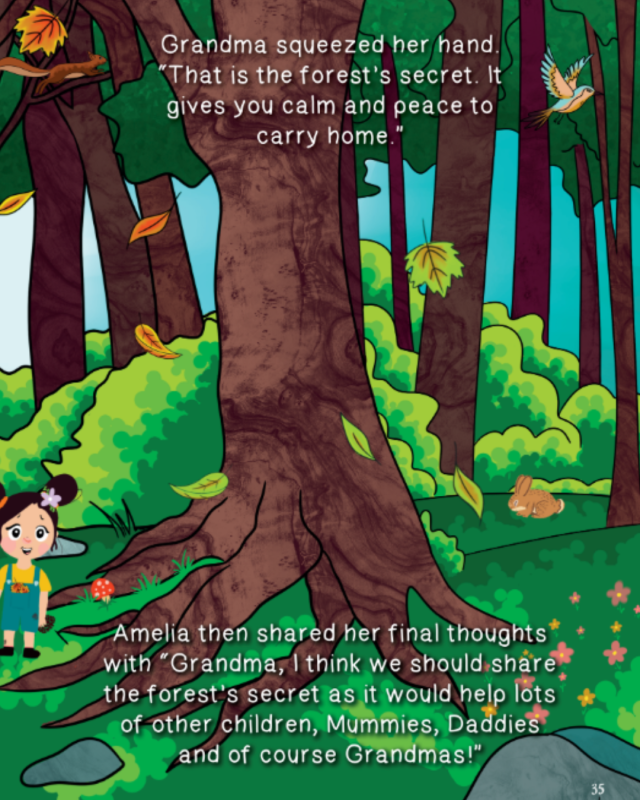
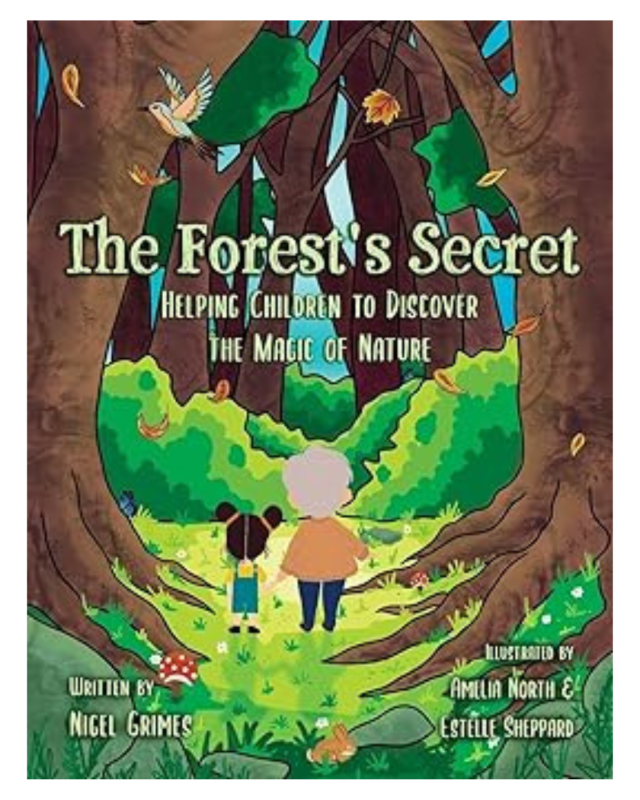
The Forest’s Secret: Helping Children Discover the Magic of Nature is
a picture book that integrates forest bathing, sensory mindfulness and
research-backed wellbeing guidance in one accessible, story-led format.
The book is available on Amazon, paperback £12.99 and hardback £19.99.
• Forest bathing, or shinrin-yoku, is a Japanese practice of immersing in nature to improve health and wellbeing by engaging all five senses. Originating in the 1980s, this evidence-based therapy is used to reduce stress and boost the immune system. It involves slow, mindful walks and deep breathing in forested areas.