New government guidance advises that under-fives should be limited to no more than one hour of screen time per day, and for under twos, the advice is to avoid screens altogether except for shared, interactive use. In response, early years experts are pressing for a more realistic conversation around what this looks like for families. Emily Burgess, director of early years at Family First Nurseries, explains why co-viewing matters, why not all screen time is equal, and how small shifts like shorter, more intentional use can make a difference.
Published
Around 98 per cent of children already use screens daily by the age of two, and amidst growing concern over fast-paced content and solo viewing, the challenge for many parents is not simply reducing screen time, but using it in a way that still supports development.
The new government guidance has brought the conversation about screen time back into focus for many families. With screens now part of everyday life from an early age, parents are increasingly asking what healthy, age-appropriate use should look like in practice.
‘Screens are a normal part of modern life, but young children still learn best through hands-on play, movement and social interaction. Guidance suggests not simply limiting screen time, but also focusing on short, meaningful sessions rather than long periods of passive viewing. When used thoughtfully, screens can support learning, but they should sit alongside, not replace, real-world experiences.
Children gain more language, more emotional understanding and more confidence when screens are used alongside an engaged adult.
What ‘quality screen time’ looks like
Not all screen use is equal, and the benefits depend on how screens are used.
High-quality content is calm, simple and designed specifically for
early years. Educational apps, story-based programmes and short videos
that encourage thinking, answering questions or naming objects offer
more developmental value than fast-paced or overstimulating content. The
goal is always to support language, curiosity and connection.
Why co-viewing matters
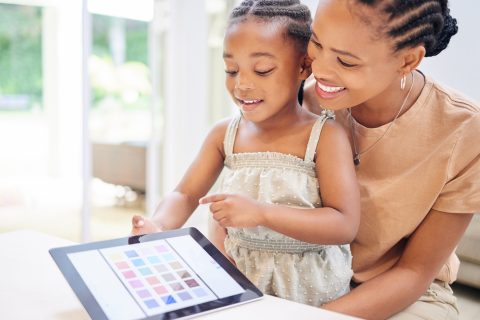
Young children understand far more when an adult is nearby.
Co-viewing, even quietly, helps them make sense of what they’re seeing.
Talking about characters, pausing to explain something, or linking the
story to real life all deepen learning. Children gain more language,
more emotional understanding and more confidence when screens are used
alongside an engaged adult. Additionally, parents can view content
before sharing it with their children to make sure it's appropriate and
aligned with their family values. This protects kids from
overstimulating or inappropriate language and allows parents to
anticipate questions and highlight learning opportunities.
How nurseries model balanced screen habits
Early years settings take a structured, developmental approach. In
nurseries, screens are used sparingly and with purpose, for
storytelling, early phonics or as part of a guided activity. The EYFS
(Early Years Foundation Stage) Statutory Framework encourages settings
to prioritise active learning, communication and physical development,
so screen use supports a wider learning goal. Children are guided
gently, with consistent routines that help them understand when screens
are helpful and when it’s time to switch off.
How parents can help
To help families feel confident, a few simple principles can make a difference:
• Short bursts work best. Use screens in short 10–15-minute sessions, with breaks for play, movement or fresh air.
• Choose calm, age-appropriate content. Favour programmes or apps
specially designed for early years, and opt for simple and slow-paced
shows that are rich in language.
• Watch together whenever possible. Even brief co-viewing helps
children ask questions, build vocabulary and understand emotions.
• Protect sleep and routines. Avoid screens in the hour before bedtime to help children wind down and settle more easily.
• Create screen-free zones. Keeping mealtimes, bedtimes and play spaces tech-free to support communication and calmer routines.
• Model the habits you want to see. Children copy adult behaviour.
Putting your own phone aside during shared moments teaches healthy
habits naturally.
Signs it’s time to limit screen use
If a child becomes irritable when a device is removed, loses interest
in play or shows signs of tiredness after long periods of viewing,
these can be cues to reduce screen time. It doesn’t need to be a cause
for worry; simply shifting to shorter sessions, calmer content and more
co-viewing can quickly restore balance.
For children with speech delays, sensory sensitivities or specific
health needs, screens can be both helpful and overwhelming. In these
situations, short, structured sessions and co-viewing become even more
important. Simple adjustments — such as choosing calmer, slower-paced
content or reducing background noise and brightness — can make screen
time feel much more manageable. Parents may find it useful to speak with
nursery staff or relevant health professionals if they need tailored
guidance, as even small changes can make a significant difference.
Screen time doesn’t need to be a source of pressure or guilt. With
gentle boundaries, thoughtful choices and shared experiences, screens
can play a positive role in children’s lives without overwhelming the
rich, real-world learning that matters most. What’s most important is
balance, ensuring little ones still have plenty of time to play,
imagine, explore and connect.
Family First is one of the UK’s fastest-growing childcare groups,
delivering high-quality, child-centred nursery care across more than 95
settings.
DID YOU KNOW?
Toddlers who spend five or more hours a day on screens are more than
twice as likely to show behavioural difficulties, according to analysis
of UK government data. Screen-time app Jolt analysed UK government child
development data to examine how different levels of daily screen
exposure relate to behavioural outcomes in toddlers.
Key findings
• 39 per cent of toddlers with 5+ hours of daily screen time show behavioural difficulties.
• 17 per cent of toddlers with low screen exposure show behavioural difficulties.
• Behavioural difficulties are more than twice as common among high-screen toddlers.